
When you compare 4K vs HD night vision binoculars, the real question is how much detail you need after dark and how far you want to push the zoom before the image falls apart. Both sensor classes record photo and video and rely on the same IR illuminator principle, but they pull ahead in different situations.
How digital night vision actually works
Digital night-vision binoculars use a CMOS sensor paired with an infrared illuminator. The IR floods the scene with light your eyes can't see, the sensor captures it, and you view a live image on a built-in screen, day or night. Because the path is fully digital, the device can also record stills and clips straight to the unit or a memory card.
Two things decide what you get from that setup: the IR reach (how far the illuminator throws usable light) and the sensor resolution (how much detail survives once that light comes back). The 4K vs HD split is mostly about the second part, so it matters most when you start zooming in.
4K vs HD night vision: where the difference shows
HD resolution is plenty for spotting movement, identifying an animal at moderate range, and confirming what's in the field. The image looks clean on the screen and the files are smaller. Where HD struggles is when you crop or zoom hard into a frame to read fine detail, like antler tines or an ear tag, because there simply aren't as many pixels to work with.
4K holds far more detail, so when you push into a subject the picture stays readable instead of turning into a soft block. Higher sensor resolution is the thing that keeps detail intact as you zoom. That's also why 4K pairs better with longer IR range and stronger zoom levels: there's no point reaching out to a distant animal if the resolution can't resolve it once you get there.
A note on zoom
Both models here use digital zoom, which crops into the existing image rather than adding optical magnification. Optical zoom would add genuine detail; digital zoom just enlarges what's already captured and softens it. This is exactly why resolution matters: a 4K frame has the headroom to survive an 8x digital crop and still look sharp, while an HD frame shows the softening much sooner.
The SightForest 4K model vs the HD model
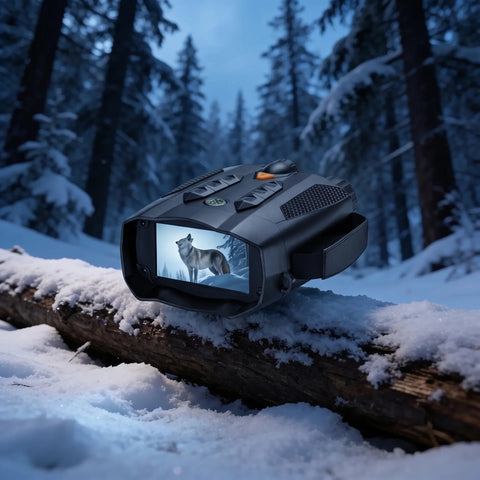
SightForest offers a clear pair to map this comparison onto. The Night Vision Binoculars 4K are the long-range, high-detail option, while the Night Vision Binoculars HD cover shorter ranges with a large, easy-to-read colour screen.
| Spec | Night Vision Binoculars 4K | Night Vision Binoculars HD |
|---|---|---|
| Photo / video | 4K photo and video | HD photo and video |
| IR viewing range | Up to ~400m | Up to ~200m |
| Infrared levels | 7-level infrared | Adjustable infrared |
| Digital zoom | Up to 8x | Not specified |
| Battery | Up to 20h | Rechargeable |
| Screen | Built-in screen | Large built-in colour screen |
The pattern is straightforward: the 4K unit reaches roughly twice as far, holds more detail, and has the zoom headroom to use that reach. The HD unit is built around an easy viewing experience at closer ranges with a generous colour screen. If you mainly want one-tap recording rather than long battery life, the Night Vision Binoculars 4K Video is a third option that records 4K video to microSD with IR to around 300m.
When HD is enough, and when 4K is worth it
- Choose HD if your subjects are usually within a couple of hundred metres, you watch more than you record, and a big, clear screen with simple controls matters more than cropping into fine detail.
- Choose 4K if you observe at longer range, you zoom in often, or you want recordings that still read well after a hard digital crop. The extra resolution and longer IR reach work together rather than in isolation.
- Think about IR range first. There's no benefit to 4K detail beyond where your illuminator can actually light the scene, so match the range to where you'll be looking before you weigh resolution.
Browse the full lineup in the night-vision binoculars collection to compare ranges and screens side by side.
FAQ
Is 4K night vision always better than HD?
Not always. 4K holds more detail and survives heavy zooming, but if you watch wildlife at closer range and rarely crop in, HD gives a clean image with a simpler, larger viewing experience. The best choice depends on range and how much you zoom.
Does higher resolution help when I zoom in?
Yes. Both models use digital zoom, which crops into the captured image rather than adding optical magnification. A 4K frame has more pixels to start with, so an 8x crop stays readable, while an HD frame softens sooner.
How far can these binoculars see in the dark?
The SightForest 4K model has IR viewing range up to around 400m, and the HD model up to around 200m. Real-world reach depends on conditions and the infrared level you select, since the illuminator is what lights the scene.
What about battery life between the two?
The 4K binoculars run up to 20 hours per charge, while the HD model is rechargeable with battery life suited to typical sessions. If long, repeated outings matter, the 4K unit's runtime is a practical advantage.
Still weighing range, zoom and screen size against your budget? Read the full night vision binoculars buying guide to match a model to how and where you'll use it.
