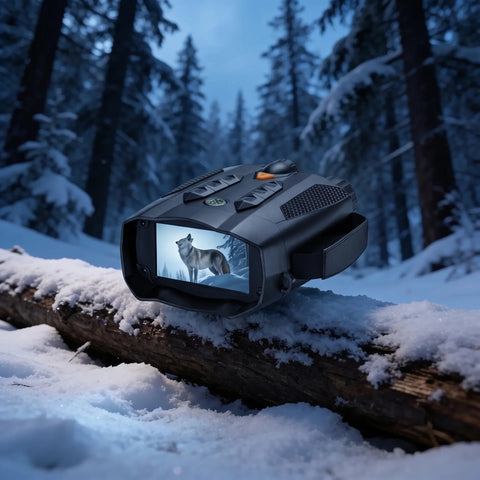

If you want to see, photograph and record wildlife in total darkness, this night vision binoculars buying guide walks you through the features that actually matter in the field, so you can match the right device to how and where you hunt or watch.
How digital night vision works
Modern night vision binoculars are digital, not analog tubes. A CMOS sensor reads the scene while a built-in infrared (IR) illuminator floods it with light your eyes cannot see. The result appears on a screen you look at, and because it is digital, the same device works in daylight too and can save photo and video to internal storage or a memory card. That makes a digital unit far more versatile than an old image-intensifier setup, and it is why every pair in our night vision binoculars collection records as well as views.
If you want the deeper background, the difference between digital and analog night vision is a topic worth exploring on its own, but for buying purposes the practical question is which sensor, IR and feature set fit your range and budget.
What to look for in this night vision binoculars buying guide
Sensor resolution: 4K vs HD
Resolution decides how much detail survives once you zoom in. A 4K sensor holds far more pixels than HD, so when you crop in on a distant deer the image stays usable instead of turning to mush. HD is perfectly capable for closer observation and general scanning, and it usually keeps the unit lighter and cheaper. The 4K-versus-HD trade-off is one of the bigger decisions here and is worth reading up on before you commit.
Infrared type and range
IR illuminators come in two common wavelengths. 850nm reaches a little farther but produces a faint red glow at the source; 940nm is fully invisible but gives you shorter effective range. Most quality binoculars also let you adjust IR power across several levels, so you can dial it down for close work and up to push distance. Stated IR ranges tell you how far the illuminator throws useful light, from roughly 200m on an entry unit to around 400m on a top model. The 850nm-versus-940nm choice deserves its own look if you care about staying completely covert.
Optical vs digital zoom
This is where a lot of buyers get caught out. Optical zoom adds genuine magnification and real detail; digital zoom simply crops the existing image and softens it. A unit quoting "up to 8x digital zoom" is enlarging pixels, which is exactly why high sensor resolution matters so much: the more pixels you start with, the better digital zoom holds together. Treat zoom numbers as a rough guide, not a detail promise, and let resolution do the heavy lifting.
Battery life and recording
Runtime varies a lot. Some binoculars push toward 20 hours of viewing, others sit nearer 8 hours, and that gap decides whether you can run a full night without recharging. Check how the device records too: one-tap video, photo capture, and whether footage saves to a built-in slot or a removable microSD you can swap and back up. If you film a lot, a roomy card such as our 128GB memory card stops you running out of space mid-session.
Built-in screen and build
A built-in colour screen means you and a companion can both see the action live, and a larger screen makes reviewing footage in the field much easier than squinting through an eyepiece. Build matters because night work happens in cold, damp conditions; look for a rechargeable unit you can run all night and recharge from a power bank or vehicle.
Compare the SightForest night vision binoculars
| Model | Photo / video | IR range | Battery | Zoom | Best for |
|---|---|---|---|---|---|
| Night Vision Binoculars 4K | 4K photo & video | To ~400m | Up to 20h | Up to 8x digital, 7-level IR | Longest range and longest runtime |
| Night Vision Binoculars 4K Video | 4K video, one-tap record | To ~300m | Up to 8h | 8x zoom | Filming-focused use with microSD |
| Night Vision Binoculars HD | HD photo & video | To ~200m | Rechargeable | Adjustable IR | Closer-range watching on a budget |
Which night vision binoculars are right for you
- Long-range hunting and all-night sessions: the Night Vision Binoculars 4K gives you the longest IR reach, 7-level infrared and up to 20 hours of runtime, so you can scan big ground without a recharge.
- Capturing footage to share or review: the Night Vision Binoculars 4K Video is built around one-tap 4K recording and a microSD slot for easy back-up.
- Closer observation and everyday wildlife watching: the Night Vision Binoculars HD pairs a large built-in colour screen with adjustable infrared for comfortable viewing inside ~200m.
Not sure which fits your ground? Our quick find my gear quiz narrows it down in under a minute based on your range, budget and how you plan to use it.
Frequently asked questions
Can night vision binoculars be used in daylight?
Yes. Because these are digital units built on a CMOS sensor, they work in normal daylight as ordinary binoculars and switch to infrared in the dark. You get one device for day and night rather than a tube-based unit that only operates after dark.
Is 850nm or 940nm infrared better?
It depends on your priority. 850nm reaches a little farther but leaves a faint red glow at the illuminator, while 940nm is completely invisible but gives shorter range. If staying covert around wary game matters most, lean toward 940nm; if maximum distance matters, 850nm wins.
Does more zoom mean more detail?
Not by itself. Optical zoom adds real magnification, but the digital zoom quoted on most binoculars just crops and enlarges the image, which softens it. Higher sensor resolution is what keeps detail sharp when you zoom in, so a 4K unit holds up far better than HD at the long end.
How much IR range do I actually need?
Match it to your ground. Around 200m suits gardens, paddocks and woodland edges; 300m covers most general hunting and observation; and roughly 400m is for open fields and long shots where you need to identify quarry well before it reaches you.
Once you have shortlisted a model, read our full night vision binoculars buying guide alongside the rest of the night vision range to compare specs side by side and pick with confidence.
