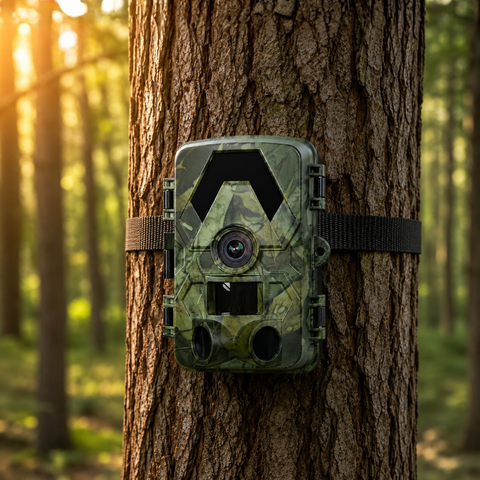

Changing trail-camera batteries every few weeks is the chore nobody enjoys — especially on a camera an hour from home. That's the promise of solar: leave it out and forget it. But are solar trail cameras worth it, or is it marketing? Here's the honest answer, including the cases where solar doesn't pay off.
How a solar trail camera works
A small panel on (or wired to) the camera tops up an internal rechargeable battery whenever there's daylight. A good panel needs only 2–3 hours of decent sun to keep the battery full, so in open ground the camera can run for months on end with no intervention.
The case for solar
- Set-and-forget. No trekking out to swap cells — less disturbance to the area and less scent left behind.
- Lower running cost. No endless packs of lithium AAs. Over a couple of seasons the savings add up.
- Less downtime. A drained camera misses everything; solar keeps it topped up so you don't lose a week to a flat battery.
- Greener. Far fewer disposable batteries in the bin.
The 4G Solar Trail Camera 4K is built around this: solar plus a rechargeable battery and dual-SIM 4G, so it runs unattended and still pushes 4K photos to your phone.
The honest downsides
- It needs light. Under heavy canopy a panel may capture only 20–30% of the sun it would in the open, so deep-woods spots charge slowly.
- Short winter days. Less daylight means less harvest; in mid-winter a shaded camera may still need a battery assist.
- Slightly higher upfront cost than a bare battery camera — offset over time by not buying batteries.
When solar is worth it (and when it isn't)
Worth it: open fields, field edges, food plots, fence lines, any spot that gets a few hours of direct sun — and especially remote cameras you can't easily revisit. Less worth it: dense, shaded forest under thick canopy, or a camera right by the house that's trivial to re-battery. For shaded spots, the fix is simple: pick a camera with strong battery backup, or add a separate solar panel you can angle toward the open sky on a short lead.
Get the most from solar
- Aim the panel south (northern hemisphere) and tilt it toward the midday sun.
- Mount where the panel catches a sun gap, even if the lens watches a shaded trail.
- Start with a fully charged battery so the panel only has to maintain, not recover.
- Keep the panel clean — dust and sap cut output.
Ready to stop changing batteries? See the 4G Solar Trail Camera 4K, add a solar panel for shaded spots, or browse all trail cameras.
FAQ
Do solar trail cameras work in winter?
Yes, but charging slows with shorter days. In open ground they usually stay topped up year-round; in shade during mid-winter, keep a charged backup battery in place.
Do solar trail cameras work under trees?
They work, but dense canopy can cut solar harvest to 20–30% of open-sky levels. Position the panel toward a sun gap, or use a model with strong battery backup.
How long does a solar trail camera last between charges?
With adequate sun, indefinitely — the panel keeps the battery topped up. Without sun, it falls back to the internal battery, which lasts weeks depending on activity.
Are solar trail cameras cheaper overall?
Usually, over time. The upfront price is a little higher, but you stop buying disposable batteries, which adds up across seasons.
Choosing your first camera? Read the complete 4G trail camera buying guide.
