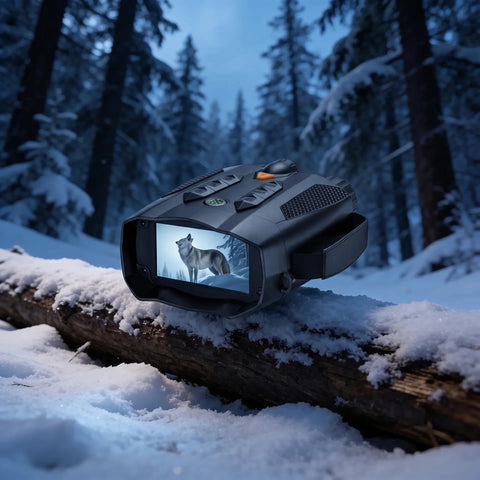

It is the first question almost everyone asks before buying a pair: how far can night vision binoculars actually see in the dark? The honest answer is that it depends on the light, the target, and what you mean by "see." In this guide we break down realistic viewing distances, explain what limits them, and show you how to get the most range out of a modern digital night vision setup.
The short answer: it depends on the light
Night vision is not a single fixed number like the zoom on a camera. The distance you can see is shaped by how much light is available, how large and reflective your target is, and whether you are relying on ambient light or a built-in infrared (IR) illuminator. On a clear night with some moonlight, a good pair of digital binoculars can let you pick out large shapes, such as deer or people, at a few hundred metres. In pitch darkness, where the device depends entirely on its own IR beam, the practical range is usually shorter.
It also matters what you mean by "see." There is a big difference between detecting that something is there, recognising what kind of animal or object it is, and identifying a specific individual. Each of those steps demands progressively more distance, contrast, and detail.
Realistic distances you can expect
Rather than quote one headline figure, it helps to think in ranges tied to the task. As a general rule of thumb for consumer digital night vision binoculars:
- Detection (something is there): often several hundred metres under decent starlight or moonlight, because you only need to catch movement or a rough silhouette.
- Recognition (what it is): typically shorter, often within roughly 100 to 200 metres, since you need enough detail to tell a fox from a badger.
- Identification (which one it is): shorter still, usually well under 100 metres, where facial or marking detail becomes readable.
- Pure IR range in total darkness: limited by the strength of the built-in illuminator, so expect meaningful detail closer in rather than far off.
These figures are guidance, not guarantees. A pale deer standing in an open field reflects far more light than a dark animal half-hidden in a hedgerow, so two targets at the same distance can look completely different through the same binoculars.
What actually limits the range
Several factors combine to decide how far your night vision will reach on any given night. Understanding them helps you set realistic expectations and choose the right conditions.
Available light
Digital night vision works by amplifying whatever light is present. A clear night with a bright moon gives you dramatically more range than an overcast, moonless one. Starlight alone is usable, but detail drops off with distance.
The infrared illuminator
When there is little or no ambient light, the device leans on its IR illuminator, effectively a torch your eyes cannot see but the sensor can. A stronger, well-focused IR beam reaches further. Some illuminators can be adjusted from a wide flood for close scanning to a tighter beam for longer distances.
Magnification and sensor resolution
Higher magnification brings distant targets closer, but it also narrows your field of view and can make the image dimmer and shakier. A higher-resolution sensor preserves more detail as you push the range, which is why higher-tier models tend to give cleaner images further out.
Atmosphere and terrain
Fog, rain, dust, and heat haze all scatter light and cut your effective range. Open, flat ground lets you see much further than woodland, where trees and undergrowth block the line of sight long before the hardware runs out of reach.
How to get the best distance
You can squeeze noticeably more range out of any night vision device with a few simple habits:
- Pick your night: a clear sky with some moonlight will always outperform a foggy, moonless one.
- Use the IR illuminator wisely: switch to a tighter beam for distance and a wider one for close-range scanning.
- Steady the image: even a fence post, a tree, or a monopod removes hand shake that blurs distant detail.
- Let your setup settle: scan slowly and give the sensor a moment on each target rather than sweeping quickly.
- Match the model to the task: if you regularly want more reach and detail, a higher-resolution 4K unit will serve you better than an entry model.
If long-distance clarity matters to you, it is worth comparing the tiers before buying. You can see the HD, 4K, and 4K Pro options side by side in the SightForest night vision binoculars collection, where the higher tiers prioritise sensor detail and IR performance for greater usable range.
Binoculars for scanning, cameras for watching
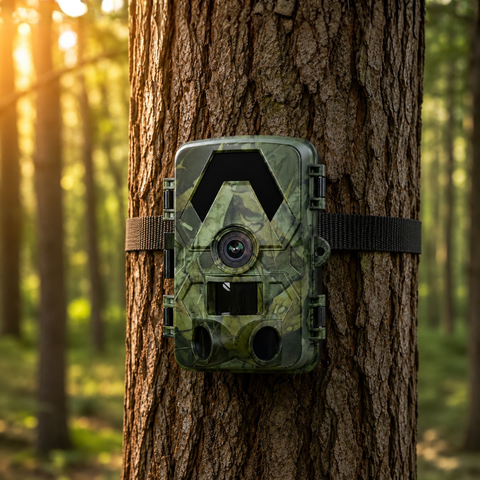
One point worth making: night vision binoculars are built for active, handheld observation, spotting wildlife, checking a treeline, or scanning a field as events unfold. They are not designed to sit unattended and record what happens while you sleep. For that job, a motion-triggered trail camera is the better tool. It waits silently, fires on movement with its own no-glow IR, and stores footage locally, so you can review what passed through after the fact.
Many outdoor enthusiasts use both together: binoculars to scan and confirm in real time, and a trail camera left in place to capture the animals that only appear when nobody is watching. If you go that route, remember our cameras record locally to microSD with no monthly subscription of any kind, so there are no ongoing fees to see your footage.
The practical takeaway
There is no single distance that answers "how far can night vision binoculars see," because the light, the target, and the conditions change every night. Expect to detect large subjects at a few hundred metres under moonlight, to recognise them somewhat closer, and to identify fine detail nearer still, with your IR illuminator setting the limit in true darkness. Choose a clear night, keep the image steady, use IR sensibly, and match the model tier to how much reach you really need. Do that, and you will get the most out of whatever the dark has to show you.
