
Choosing between night vision and thermal imaging is one of the most common questions for anyone shopping for after-dark optics or cameras. Both let you see when there is little or no light, but they work in completely different ways and suit different jobs. This guide breaks down how each technology works, where it shines, and which one makes more sense for your budget and your use case.
How night vision and thermal actually work
Understanding the core difference makes the buying decision far easier. It comes down to what each device is designed to detect: light versus heat.
Night vision: amplifying available light
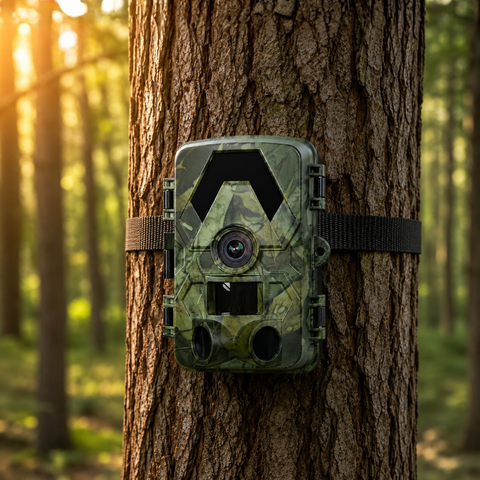
Night vision works by collecting the small amount of ambient light present at night, from the moon, stars, or infrared (IR) illumination, and amplifying it into a bright, detailed image. Digital and IR-assisted devices add their own invisible infrared light to "paint" the scene, which is exactly how a good trail camera captures sharp footage in total darkness. The result looks like a real picture: you can read antler shapes, fur patterns, faces, number plates and other fine detail.
Thermal: detecting heat signatures
Thermal imaging ignores light entirely. Instead it detects the heat that every object emits and turns temperature differences into an image, usually showing warm bodies as bright shapes against a cooler background. Because it needs no light at all, thermal sees through total darkness, light fog, smoke and even dense foliage that would hide an animal from the eye. The trade-off is detail: a thermal image tells you something warm is there, but rarely gives you the fine features to identify exactly what it is.
Night vision vs thermal: the key differences
Here is a quick side-by-side of the practical differences that matter most when you are deciding what to buy:
- Image detail: Night vision wins for recognising species, faces and markings. Thermal wins for simply detecting presence.
- Detection through cover: Thermal spots warm bodies through brush, tall grass and light fog. Night vision needs a relatively clear line of sight.
- Light conditions: Thermal works in absolute darkness with zero ambient light. Night vision needs some light or its own IR illuminator.
- Daytime use: Thermal works day and night. Traditional night vision is a night-time tool.
- Range: Thermal often detects heat at longer distances, while night vision typically gives clearer identification at closer range.
- Price: Night vision is far more affordable. Thermal remains a premium technology and usually costs several times more for comparable performance.
Which should you buy for your use case?
The right choice depends entirely on what you want to do after dark. Here is how the two technologies map to the most common needs.
Wildlife watching and photography
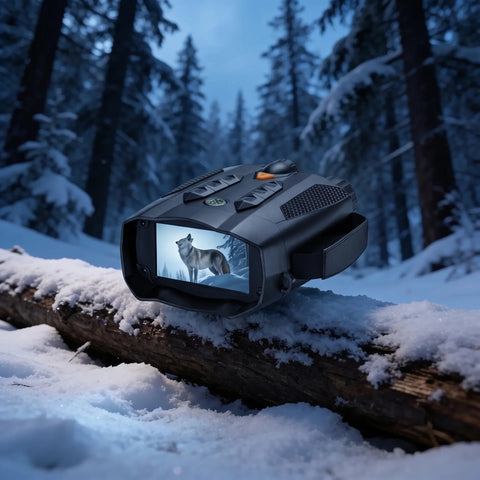
If you want to see and identify animals, night vision is almost always the better value. You get a genuine, recognisable image of foxes, deer, badgers or owls rather than a warm blob. Our night vision binoculars come in HD, 4K and 4K Pro tiers so you can match detail and range to your budget, and they double as everyday spotting optics.
Monitoring a property, plot or feeding site
For unattended monitoring, a trail camera is the smarter tool than any handheld device, because it records automatically whenever something moves. Our cameras use a PIR motion trigger with no-glow infrared to roughly 20 metres, capture 4K UHD video and 60MP stills, and are built to IP66 against rain and dust with a wide 112 to 130 degree field of view. Because they use invisible no-glow IR, they stay discreet at night while still delivering a clear, identifiable image.
- Offline sites with no signal: The SD Trail Camera 4K stores everything to a microSD card (up to 128GB), so you simply swap the card and review footage at home. No signal, no fuss.
- Nearby monitoring: The WiFi Trail Camera 4K lets you check clips on your phone from close range over its own app.
- Remote monitoring: The 4G and 4G Solar models send images to your phone over the mobile network using your own standard nano-SIM (not included, and never an eSIM). The solar version keeps its battery topped up so you can leave it out for long stretches.
Crucially, there is no monthly subscription on any of our cameras, ever. You pay once for the hardware and, on cellular models, only for your own SIM data plan.
Search, detection and open ground
If your priority is finding warm bodies quickly across open fields, through fog, or in areas where animals hide in cover, thermal has a real edge. Its ability to reveal heat where the eye and even night vision see nothing is genuinely useful for scanning large or cluttered terrain. Just be prepared for the higher cost and the loss of fine visual detail.
Can you have the best of both?
Many people end up combining approaches rather than picking a single winner. A common and cost-effective setup is a pair of night vision binoculars for active observation, paired with a trail camera to watch a spot around the clock while you are away. That gives you clear, identifiable images at a fraction of the price of premium thermal gear, and covers far more scenarios.
In short: choose night vision if you want to clearly identify what you are looking at and keep costs sensible, choose thermal if pure heat detection through cover and darkness is your priority and budget is less of a concern, and consider a trail camera whenever you want hands-free, round-the-clock monitoring. Browse the full trail camera range and the night vision collection to match the right tool to your needs, all backed by our 3-year warranty and 30-day returns.
