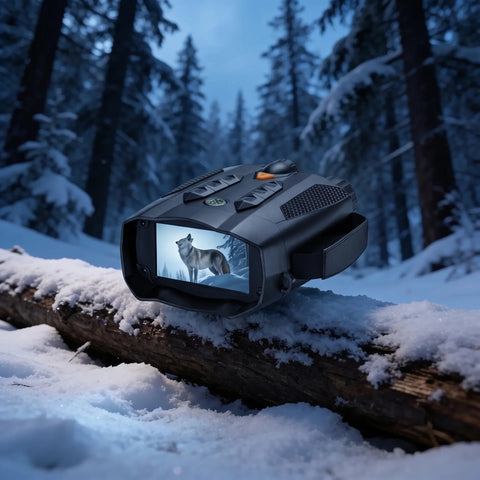

When you read a night-vision spec sheet, the zoom figure can be misleading. Understanding optical vs digital zoom is the difference between actually pulling a distant deer closer and just magnifying a blurry patch of pixels in the dark.
Optical vs digital zoom: the core difference
The two work in completely different ways, and only one adds real detail to what you see.
- Optical zoom moves the physical lens elements to magnify the scene before it ever hits the sensor. You gather more detail from the subject, so the image stays sharp as you zoom in. This is "true" zoom.
- Digital zoom does no optics at all. It crops into the centre of the image the sensor already captured and stretches those pixels to fill the screen. Nothing new is gathered, so the result looks softer and grainier the further you push it.
Digital night vision is built around a CMOS sensor and an IR illuminator rather than the analogue image-intensifier tubes of older units. Because the picture is digital from the start, most night-vision binoculars rely heavily on digital zoom. That is not automatically a problem, but it changes how you should read the numbers.
How to read an "up to 8x" spec
When a product lists "up to 8x" zoom, that figure is almost always the maximum digital magnification, not optical. The Night Vision Binoculars 4K are rated up to 8x digital zoom, and so is the Night Vision Binoculars 4K Video. The "8x" tells you how far the device can crop in, not how much real detail survives at the far end of that range.
This is where sensor resolution matters. A higher-resolution sensor captures more pixels to begin with, so when the unit crops in for digital zoom there is more detail left to work with. A 4K device holds usable detail deeper into its zoom range than a lower-resolution one. In practice, the first part of the zoom range looks crisp, and quality tapers off as you approach the maximum. Treat "up to 8x" as a ceiling you reach occasionally, not a setting you live at.
| Aspect | Optical zoom | Digital zoom |
|---|---|---|
| How it works | Lens elements move to magnify before the sensor | Crops and enlarges existing pixels |
| Detail | Adds real detail | Adds no detail; softens the image |
| Best use | Pulling distant subjects genuinely closer | Framing and quick reach when detail loss is acceptable |
| Typical in night vision | Rare on digital units | Standard, shown as "up to Nx" |
Why zoom behaves differently in low light
Digital zoom is harsher at night than in daylight. In the dark your image is already working against limited light and the reach of the IR illuminator, so cropping into it magnifies noise as well as the subject. Two factors set the real limit on what you can identify at range:
- IR illuminator reach. Your IR beam only lights so far. The 4K binoculars push infrared viewing to roughly 400m, the 4K Video model to around 300m, and the Night Vision Binoculars HD to about 200m. Zooming past the edge of your IR light just enlarges darkness.
- IR wavelength. 850nm IR reaches a little farther but leaves a faint red glow that some animals notice. 940nm is invisible but covers less distance. The wavelength caps how far you can usefully zoom before the subject falls into shadow.
So zoom and IR reach are linked. There is no point dialing in maximum digital zoom on a target that sits beyond your illuminator's range.
Using zoom well in the field
- Spot and scan at low zoom first. A wider view finds movement faster and keeps the image bright.
- Zoom in only to confirm or identify, then back out. Lingering at maximum zoom tires your eyes and shows you the noisiest version of the scene.
- Brace or rest the binoculars when zoomed in. Digital magnification exaggerates hand shake just as it exaggerates everything else.
- Let the IR level and zoom work together. Raising the infrared output, where the unit has adjustable or multi-level IR, often does more for a distant subject than another notch of digital zoom.
The 4K and 4K Video models offer multi-level infrared (the 4K unit has seven IR levels), so you can match illumination to distance before you reach for more magnification.
Which night-vision binocular for your range
Match the device to how far you genuinely need to see, since that sets the ceiling on useful zoom:
- Longest reach and battery: the 4K model, with IR to roughly 400m and up to 20 hours of runtime, gives the most headroom for zooming into distant subjects.
- Dedicated recording: the 4K Video model adds one-tap 4K recording and microSD, with IR to around 300m.
- Closer, simpler use: the HD model, with a large colour screen and IR to about 200m, suits yard, paddock and woodland-edge distances.
You can compare the full lineup in the night-vision binoculars collection and pick the IR range that fits your ground.
FAQ
Does optical vs digital zoom matter more at night?
Yes. At night the image is already limited by light and IR reach, so digital zoom's softening and noise show up more than they would in daylight. Detail you would lose only slightly by day can become unusable in the dark.
What does "up to 8x" actually mean?
It is the maximum digital magnification the device can apply. It tells you how far the unit can crop in, not how much sharp detail remains at the far end. Higher sensor resolution keeps more of that detail intact as you zoom.
Is digital zoom on night-vision binoculars useless?
No. The early part of the zoom range is genuinely useful for framing and identifying, especially on a 4K sensor with plenty of pixels to spare. It only disappoints when you push to the maximum on subjects beyond your IR illuminator's reach.
Can I improve a distant subject without zooming?
Often, yes. Raising the IR level on a unit with adjustable or multi-level infrared lights the subject better, which usually beats adding another notch of digital zoom that only magnifies the existing noise.
For help weighing sensor resolution, IR range and screen type across the full range, read our night-vision binoculars buying guide.
