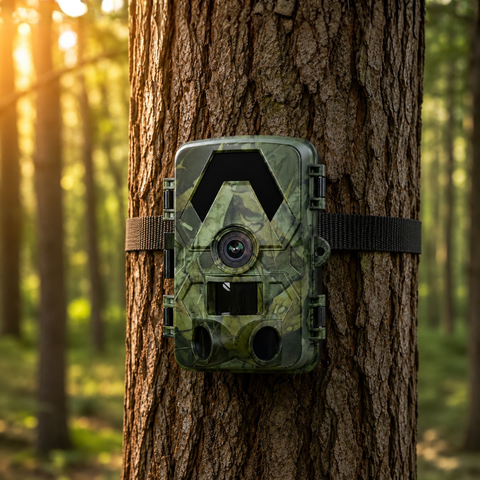

Shopping for a wildlife camera means wading through a soup of abbreviations: PIR, IR, FOV, IP66, MP. Each one describes something that genuinely affects the photos and videos you get back, but spec sheets rarely stop to explain them. This glossary breaks down the terms that matter most, in plain English, so you can compare models on facts rather than marketing.
Detection and triggering terms
These terms describe how a trail camera notices an animal and decides to take a shot. They are the difference between a full memory card of wildlife and a card full of empty frames.
- PIR (Passive Infrared) sensor — The motion detector at the heart of every trail camera. It senses the difference in heat between a warm animal and the cooler background, and fires the shutter when something moving crosses its field. Because it reacts to heat plus movement, it ignores a gently swaying branch but catches a passing deer. Every SightForest trail camera uses a PIR trigger.
- Trigger speed — The gap between the PIR sensor detecting motion and the camera capturing the image. A faster trigger means you are more likely to photograph a fast-moving animal before it leaves the frame, rather than catching only its tail.
- Recovery time — How long the camera needs after one capture before it can trigger again. Shorter recovery means fewer missed moments when several animals pass in quick succession.
- Detection range — The maximum distance at which the PIR sensor can reliably pick up an animal. Beyond this range, movement may go unrecorded even if it is within the lens's view.
- Detection angle — The width of the cone the PIR sensor monitors. A wider detection angle covers more of a trail or clearing, so animals are spotted sooner as they enter the scene.
Imaging and night-vision terms
Once the camera triggers, these specifications determine how good the resulting photo or video actually looks, by day and after dark.
- IR (Infrared) illumination — The light source a camera uses to see in the dark. Infrared sits just beyond what the human eye can detect, so the camera can light up a scene at night without a visible flash.
- No-glow IR — A type of infrared that emits no visible red glow from the LEDs, so the camera stays discreet and does not startle wary animals. SightForest cameras use no-glow IR that reaches to roughly 20 metres, giving you usable night footage while staying inconspicuous.
- MP (Megapixels) — A measure of photo resolution. Our trail cameras deliver 60MP still photos, which means plenty of detail for identifying individual animals or reading fine markings.
- 4K UHD — Ultra High Definition video, four times the detail of standard Full HD. All SightForest trail cameras record 4K UHD, so you can crop into footage or view it on a large screen without it turning to mush.
- FOV (Field of View) — The width of the scene the lens actually captures, measured in degrees. A wider FOV takes in more of a clearing or trail. SightForest cameras offer a field of view between 112 and 130 degrees depending on the model, which is generous for covering feeding areas and paths.
It is worth noting that detection angle (what the PIR senses) and field of view (what the lens captures) are not the same number. Ideally they overlap well, so anything the camera notices also lands inside the frame.
Power, storage and durability terms
These terms cover the practical side: keeping the camera running, storing what it captures, and surviving the weather.
- IP66 — An Ingress Protection rating. The first digit (6) means fully dust-tight; the second digit (6) means protected against powerful jets of water. In practice, an IP66 camera like ours shrugs off heavy rain and dusty conditions, which is exactly what a device left outdoors for weeks needs.
- microSD — The small memory card that stores your photos and videos locally. SightForest cameras support cards up to 128GB, and our 128GB microSD card gives you room for thousands of 4K clips before you need to swap it.
- Cellular / 4G — A camera that sends images to your phone over the mobile network, so you can check a remote spot without visiting it. Our 4G models use your own standard nano-SIM (not included) — a normal nano-SIM from any carrier, never an eSIM. Crucially, there is no monthly subscription to SightForest: you simply use a data plan of your choice.
- Solar — A built-in or attached solar panel that tops up the battery, so a well-placed camera can run for long stretches without a battery change. Our 4G Solar Trail Camera 4K combines cellular delivery with solar charging for true set-and-forget monitoring.
- Time-lapse — A mode that captures frames at set intervals regardless of motion, useful for watching how a scene changes over hours or days, such as a fruiting tree or a waterhole.
How connectivity types compare
One of the first choices you will face is how the camera hands you its footage. There are three common approaches, and the right one depends on how far the camera sits from you.
- Offline (SD only) — The camera saves everything to its microSD card and you collect the card in person. Simple, private, and with no running costs, this suits gardens and easily reached spots. See the SD Trail Camera 4K.
- WiFi — You connect to the camera with your phone on-site to review and download footage without pulling the card. Handy when the camera is mounted somewhere awkward to reach, though you still need to be near it.
- Cellular (4G) — Images come to your phone from anywhere with mobile coverage, ideal for distant or hard-to-visit locations. Remember, this needs your own nano-SIM, and there is still no subscription owed to us.
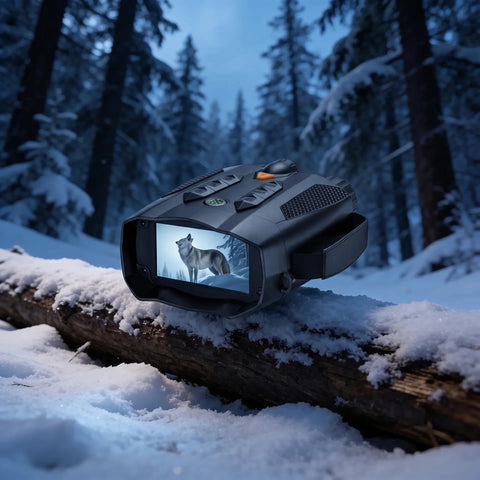
You can compare all of these side by side in our trail camera collection. If you also want to observe wildlife live with your own eyes rather than reviewing captures later, our night vision binoculars are a natural companion.
Reading a spec sheet with confidence
With these terms in hand, a spec sheet stops being a wall of jargon and becomes a straightforward checklist. Look at PIR detection range and trigger speed to judge how reliably the camera will catch movement, check the FOV and megapixels to know what the image will look like, confirm the IP rating for your climate, and decide whether offline, WiFi or 4G delivery fits how you will actually use it. Every SightForest camera ships with a 3-year warranty and a 30-day returns window, and orders are dispatched in around 48 hours with tracked delivery in 7 to 9 business days, so you can put the right terminology into practice without second-guessing your purchase.
