
Watching a blue tit ferry caterpillars to a hungry brood, or catching a robin's first tentative visit to a new nest box, is one of the quiet joys of a European garden. A trail camera lets you follow that story around the clock without hovering nearby and scaring the birds off. In this guide we explain what actually matters when you point one of these cameras at your feeders, hedgerows and nest boxes.
Why a trail camera beats sitting by the window
Garden birds are shy, fast and active at dawn and dusk when you are rarely watching. A weatherproof trail camera solves all three problems at once: it runs unattended for weeks, triggers itself the moment something moves, and keeps recording in near-darkness. Because it is designed to be left outdoors and forgotten, you capture natural behaviour that disappears the second a human appears.
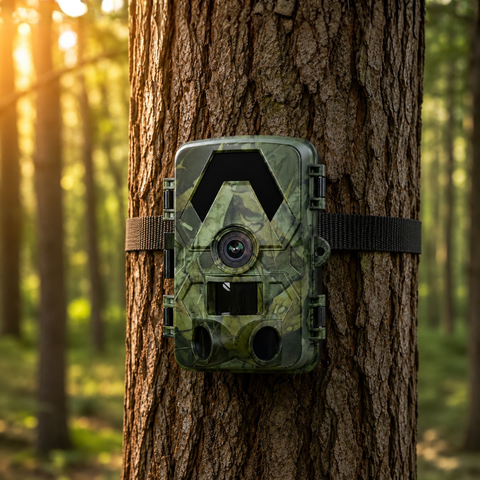
The key features to look for when birding are silence, sensitivity and low-light performance:
- No-glow infrared — invisible IR illumination out to roughly 20 m means nocturnal or roosting birds are never startled by a visible flash.
- A responsive PIR sensor — passive infrared motion detection fires the shutter when a warm body enters the frame, so you are not left scrubbing through hours of empty footage.
- 4K UHD video and 60MP stills — enough resolution to identify plumage detail, ring numbers and subtle field marks.
- A wide 112–130° field of view — covers a whole feeding station or the approach to a nest box without clipping wings.
- IP66 weatherproofing — shrugs off the rain and cold that come with year-round European garden use.
Every camera in the SightForest trail camera range shares these core specs, so the real choice is about how you want to receive the footage, not the image quality itself.
Nest box cameras: getting the placement right
Nest boxes are a special case. The space is tight, the light is poor, and any disturbance during the breeding season can cause a bird to abandon the nest. A few practical rules make all the difference:
- Install before the season starts. Late winter, well before birds begin prospecting for sites, gives them time to accept the camera as part of the furniture.
- Mount outside, looking in — or nearby, looking out. Because the minimum focus and wide angle suit open scenes better than a cramped interior, many birders position the camera a metre or two away, framed on the entrance hole to log every arrival and departure.
- Respect the law. Across much of Europe, active nests of wild birds are legally protected. Never open or handle an occupied box, and let the camera do the watching once nesting is underway.
- Use a generous memory card. A brood generates hundreds of feeding trips a day. Our cameras take microSD cards up to 128GB, and a dedicated 128GB microSD card comfortably holds weeks of triggered clips.
Set the camera to short video bursts rather than continuous recording. You will conserve both battery and storage while still capturing the moments that matter.
Which SightForest model suits your garden?
All four cameras deliver the same 4K image, no-glow IR and PIR triggering. The difference is how you get to the footage.
- SD Trail Camera 4K (€99.99) — the simplest option. It records to a microSD card that you swap out and read on a computer, with no app, no signal and nothing to configure. Ideal for a quiet corner of the garden you visit regularly. See the SD Trail Camera 4K.
- WiFi Trail Camera 4K (€129.99) — connects to your phone over its own local WiFi when you are within range, so you can review and download clips from the garden bench without unmounting the camera. Perfect for a nest box near the house.
- 4G Trail Camera 4K (€159.99) — sends images straight to your phone over the mobile network, so you can follow a distant hedgerow or allotment nest box from indoors. It uses your own standard nano-SIM (not included) — a normal data SIM, never an eSIM.
- 4G Solar Trail Camera 4K (€279.99) — the same cellular convenience with an integrated solar panel, built for locations you would rather not visit for months. Again, it takes your own standard nano-SIM (not included).
One thing every model has in common: there is no monthly subscription, ever. The cellular cameras use an ordinary pay-as-you-go or contract data SIM of your choosing, and the SD and WiFi models need no network at all. You buy the camera once and it is yours to run however you like.
When to reach for binoculars instead
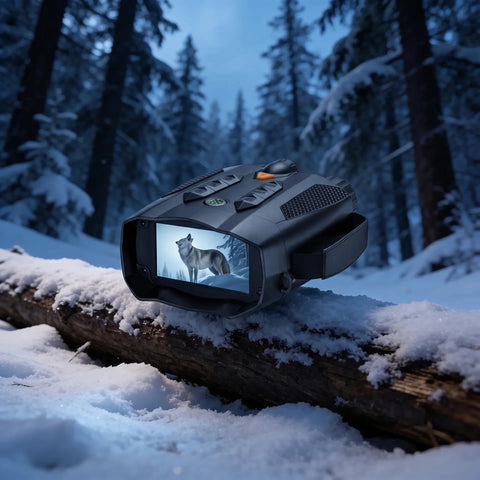
A trail camera is unbeatable for unattended, long-term monitoring, but it will never replace the pleasure of watching a bird in real time. For active observation at the feeder or on an evening walk, a pair from the night vision binoculars collection complements a fixed camera nicely — the camera logs what happens while you are away, the binoculars let you enjoy what happens while you are there.
Practical setup tips before you buy
A little planning turns a good camera into a great one:
- Mount at bird height, angled slightly downward, and clear any twigs that might wave in the wind and trigger false captures.
- Face the lens away from direct sun and from the low morning and evening light that causes glare.
- Keep it 1–3 m from feeders or nest-box entrances so the wide field of view frames the action without cutting off wings in flight.
- Format the microSD card in the camera before first use, and check your footage after a couple of days to fine-tune the position.
A quiet window onto garden life
The best birdwatching camera is the one that matches how you like to work: swap-the-card simplicity, on-site WiFi review, or full remote access from your armchair. Whichever you choose, you get 4K clarity, silent no-glow night vision and no ongoing fees. SightForest orders are dispatched within about 48 hours and arrive by tracked delivery in 7–9 business days, backed by a 3-year warranty and 30-day returns — so you can have a camera watching over your nest boxes well before the breeding season begins. Browse the full trail camera collection to find the right fit for your garden.
