
Trail cameras were designed to watch wildlife, but the same rugged, weatherproof, motion-triggered hardware is quietly transforming how farms keep an eye on livestock and property. Whether you are checking a calving pen at 3 a.m. without leaving the house, watching a remote gate for intruders, or confirming that your ewes are still where you left them, a well-placed camera saves hours of driving and walking. This guide explains where farm cameras earn their keep and how to choose the right model for your holding.
Why farmers are adopting trail cameras
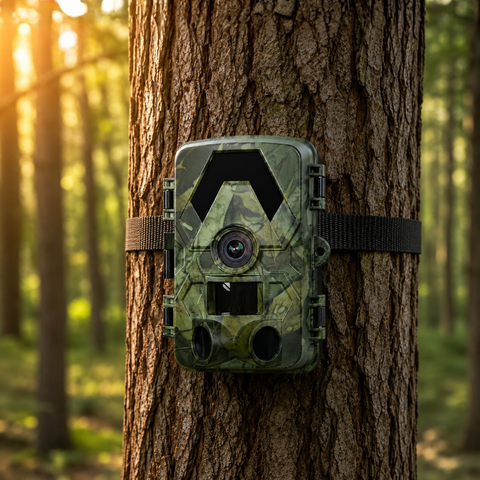
A modern trail camera is built for exactly the conditions a farm throws at it: rain, dust, temperature swings and long unattended stretches far from mains power. The core hardware SightForest sells is genuinely field-grade, with 4K UHD video and 60MP photos, a passive infrared (PIR) sensor that fires the moment something moves, and no-glow infrared illumination that reaches roughly 20 metres in total darkness without spooking animals. An IP66 weatherproof rating and support for microSD cards up to 128GB mean you can mount one and largely forget about it.
For agricultural use, that translates into a long list of practical jobs:
- Calving and lambing: monitor maternity pens overnight so you only walk out when an animal genuinely needs you.
- Remote pasture checks: confirm stock are present, watered and undisturbed on outlying fields without a daily round trip.
- Gates and access points: record vehicles and people entering yards, tracks and field entrances.
- Outbuildings and machinery: keep watch over barns, fuel stores and parked equipment when nobody is around.
- Predator and pest activity: identify foxes, badgers or other visitors around poultry and young stock.
- Fence-line and boundary issues: catch where animals are escaping or where trespass keeps happening.
Because the cameras trigger only on movement, you review short clips of actual events instead of scrubbing through hours of empty footage.
Choosing the right camera for your farm
The best choice depends almost entirely on one question: how far is the camera from you, and how quickly do you need to see what it captures? SightForest offers four camera types across the trail camera collection, and each suits a different situation.
Offline: the SD Trail Camera 4K
The SD Trail Camera 4K (from €99.99) records everything to a microSD card with no connectivity at all. It is the simplest, most affordable option and ideal for spots you visit regularly anyway, such as a calving shed, a barn or a yard corner. You collect the card when you pass by and review footage on any computer or phone. With no signal to depend on, it works absolutely anywhere. Pair it with a 128GB microSD card so it can store weeks of clips before you need to swap it.
On-site WiFi: the WiFi Trail Camera 4K
The WiFi Trail Camera 4K (€129.99) lets you pull footage to your phone over its own local connection when you are within range, typically around the yard or a nearby building. There is no card-swapping walk and no cellular cost. It suits fixed locations near where you spend time, such as a stable block, a main gate or the farmyard itself.
Cellular: the 4G Trail Camera 4K
For fields and buildings you cannot easily reach, the 4G Trail Camera 4K (€159.99) sends images and alerts straight to your phone over the mobile network, wherever you are. This is the model that saves the most driving. It uses your own standard nano-SIM (not included) from any mobile provider with coverage at the site. Note that it is a normal nano-SIM, not an eSIM. Crucially, there is no monthly subscription to SightForest, ever; you simply pay your chosen SIM's data plan and nothing else.
Solar and cellular: the 4G Solar Trail Camera 4K
For truly remote, off-grid locations, the 4G Solar Trail Camera 4K (€279.99) combines cellular alerts with an integrated solar panel, so it keeps itself charged through the seasons. Mount it on an outlying gate, a distant water trough or a boundary you rarely reach, and it can run for long stretches with no battery changes and no visits. Like the standard 4G model, it needs your own standard nano-SIM (not included) and carries no monthly subscription.
Getting the most from your farm cameras
A few practical habits make trail cameras far more effective in an agricultural setting:
- Mount at animal height, not human height: aim the PIR sensor across the area animals actually move through, usually around 60 to 100 cm off the ground for cattle and sheep.
- Mind the field of view: these cameras cover a wide 112 to 130 degree angle, so a single well-placed unit can watch an entire gateway or pen.
- Check cellular coverage first: before committing a 4G camera to a far field, confirm your SIM provider actually has signal there.
- Angle away from the sun and moving vegetation: long grass and branches waving in the wind can cause false triggers; clear the sensor's line of sight.
- Keep spare storage on hand: a second microSD card lets you swap and review without downtime.
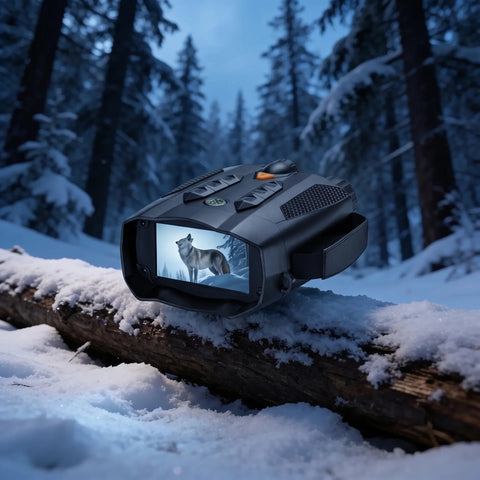
For daytime scanning of distant stock or checking activity across a valley in low light, a pair of night-vision binoculars complements fixed cameras well, letting you actively look wherever a camera is not mounted.
Buying with confidence
Every SightForest camera ships from our suppliers with dispatch in around 48 hours and tracked delivery across Europe in roughly 7 to 9 business days. Each is backed by a 3-year warranty and a 30-day return window, so you can install one and be sure it fits your farm before committing. There are no ongoing platform fees on any model; the only running cost is the data plan on your own SIM, and only if you choose a 4G camera.
The right starting point is your access, not your budget. If a location is somewhere you already pass, an offline SD or WiFi camera is the most economical answer. If it is somewhere driving to costs you real time, a 4G or 4G Solar camera pays for itself in saved journeys. Match the camera to how remote the job is, mount it thoughtfully, and you gain a quiet, tireless extra pair of eyes across the whole holding.
