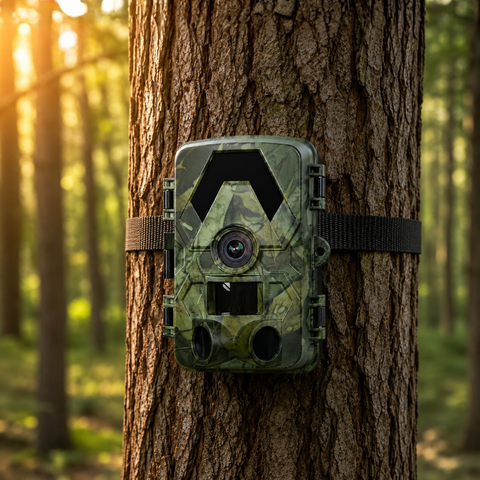
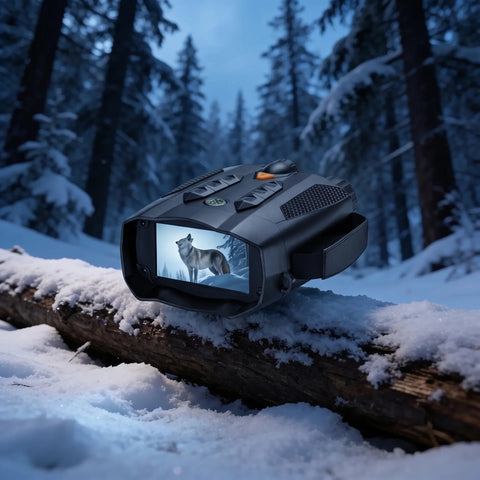

A good trail camera for security turns a blind spot at your gate, cabin or outbuilding into a live feed you can check from your phone. The right model sends instant alerts the moment someone enters the frame, stays invisible at night, and keeps working through rain, frost and heat.
What matters in a trail camera for security
A camera built for wildlife will technically work for property monitoring, but security has a different priority list. You are not waiting to review photos next week. You want to know what is happening now, and you do not want the camera giving itself away. Here is what to weigh up before you buy.
- Instant 4G alerts. A cellular camera sends a photo or clip to your phone the moment it triggers, anywhere you have signal. That is the difference between catching an intruder in the act and finding out days later. Dual-SIM models switch automatically to whichever network is strongest, so a single weak provider does not leave you blind.
- No-glow stealth. Security cameras need to stay unseen. No-glow IR uses 940nm illumination that is invisible to the human eye, so there is no faint red glow to spot in the dark. Low-glow (850nm) reaches slightly farther but shows a dim red telltale that gives the camera's position away. For property work, no-glow is the safer choice.
- Fast trigger speed. A slow camera captures the empty frame after a person has already walked through. A 0.3s trigger catches the subject while they are still in shot, which matters far more for a moving intruder than for a deer browsing in one spot.
- Weatherproofing. An IP66 rating and a wide operating temperature range mean the camera keeps recording through driving rain and hard frost, not just on calm days.
- Discreet placement. Smaller bodies, muted housings and high mounting points all make a camera harder to find and harder to reach. Pair that with no-glow IR and the camera does its job without becoming a target itself.
Best trail camera for security: our picks
Most property and cabin owners are choosing between three setups: a connected camera with a screen for everyday monitoring, a budget offline camera for a low-risk spot, and a fully self-powered unit for a remote site with no mains power.
Best all-rounder: the 4G+ Trail Camera with built-in screen
For monitoring a gate, drive or outbuilding, the 4G+ Trail Camera is the one we point most people to. It shoots 4K at 36MP, runs dual-SIM 4G with automatic network switching, and uses no-glow IR out to 20m so it stays invisible at night. The built-in 2.4 inch colour screen is the standout feature for security: you can frame the shot, set the detection zone and confirm the camera is covering exactly the right ground while you are standing at the post, with no laptop and no guesswork. A PIR sensor handles motion detection, and the IP66 housing copes with the weather year-round.
Best on a budget: the Full HD 1080P Trail Camera
If you want a watchful eye on a lower-risk spot, a shed, a back fence, a feed store, the Full HD 1080P Trail Camera does the core job without a SIM or a monthly data cost. It records 1080p at 20MP to a microSD card, runs on AA batteries, and uses the same no-glow IR to 20m so it stays discreet. There are no live alerts here; you pull the card to review footage. That trade-off keeps it simple and affordable, and it is a sensible second camera to cover a secondary angle alongside a connected unit.
Best for remote sites: the 4G Solar flagship
For land, a far paddock or a cabin where you cannot easily get to the camera to swap batteries, the 4G Solar Trail Camera 4K is built to be left alone. It pairs a solar panel with a rechargeable battery so it keeps itself topped up, shoots 4K at 48MP, and triggers in 0.3s. No-glow IR reaches 25m, the IP66 body handles a -20 to 60C range, and dual-SIM 4G keeps the alerts coming from sites a long way from anywhere.
Comparison: which security camera fits your site
| Model | Resolution | Connectivity | Power | No-glow IR range | Best for |
|---|---|---|---|---|---|
| 4G+ Trail Camera (built-in screen) | 4K / 36MP | Dual-SIM 4G | Standard battery | 20m | Gates, drives, outbuildings you can reach |
| Full HD 1080P Trail Camera | 1080p / 20MP | Offline (microSD) | AA batteries | 20m | Budget cover for low-risk spots |
| 4G Solar Trail Camera 4K | 4K / 48MP | Dual-SIM 4G | Solar + rechargeable | 25m | Remote land and cabins, no mains power |
Want to see the full range side by side? Browse all of our trail cameras to compare specs and pick the body that suits your site.
FAQ
Do I need a 4G camera for property security?
If you want to know about activity as it happens, yes. A 4G camera sends alerts straight to your phone wherever you have signal, so you can act in the moment. An offline camera like the 1080P model still records everything, but you only see the footage when you collect the card, which suits lower-risk spots rather than your main point of entry.
Will a trail camera work at night without being seen?
Yes, as long as it uses no-glow infrared. No-glow IR runs at 940nm, which is invisible to the human eye, so the camera records in the dark with no red glow to give its position away. All three models here use no-glow IR, reaching 20m to 25m depending on the unit.
How far should a security trail camera see in the dark?
For most gates, drives and yards, an IR range of 20m to 25m covers the area you care about. The 4G+ and 1080P models reach 20m, while the 4G Solar flagship pushes to 25m. Mount the camera so the zone you want to protect sits comfortably inside that range rather than at the very edge of it.
Can one camera cover a whole property?
Rarely. One camera covers one angle well, so most owners place a connected camera on the main entry point and add a budget unit such as the 1080P on a secondary route. Two well-placed cameras beat one trying to watch everything.
Still weighing up the stealth question? Read our guide on no-glow vs low-glow trail cameras for the full picture, or work through our complete guide to choosing a 4G trail camera to match a model to your site.
