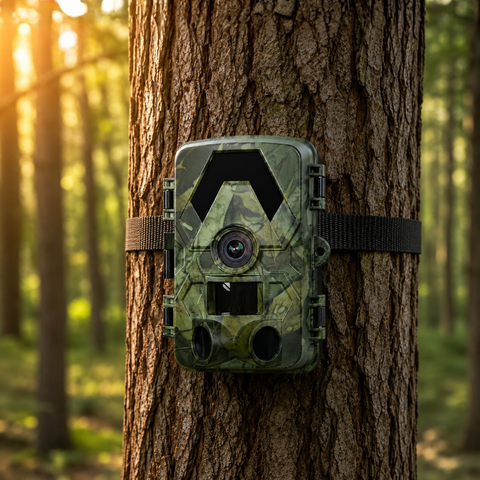

At night, every trail camera lights the scene with an infrared (IR) flash you can't fully see — but animals and people sometimes can. That comes down to one spec: no-glow vs low-glow. Pick wrong and you either spook wary game and tip off trespassers, or you lose night range you needed. Here's the difference in plain English.
How trail camera night vision works
A trail camera has no visible-light flash. Instead it fires a bank of infrared LEDs that the camera sensor can see but the human eye mostly can't. The wavelength of those LEDs — measured in nanometres (nm) — decides how visible the flash is and how far it reaches.
No-glow (940 nm)
- Completely invisible. 940 nm sits far enough into the infrared that neither animals nor people see any glow at all.
- Best for: wary mature bucks, security, and any spot where you don't want the camera noticed.
- Trade-off: camera sensors are a little less sensitive at 940 nm, so effective night range is usually slightly shorter.
Every SightForest camera uses no-glow IR — the discreet choice — rated to 20–25 m depending on model.
Low-glow (850 nm)
- Slightly longer reach. 850 nm is brighter to the sensor, so it can light targets a bit farther out.
- Faint red glow. The LEDs emit a dim red light some animals (and sharp-eyed people) can notice.
- Best for: open spots where maximum range matters more than staying hidden.
No-glow vs low-glow at a glance
| No-glow (940 nm) | Low-glow (850 nm) | |
|---|---|---|
| Visible flash | None | Faint red glow |
| Night range | Slightly shorter | Slightly longer |
| Stealth | Best | Lower |
| Ideal use | Wary game, security | Open ground, max range |
Which should you choose?
For most hunters, scouters and anyone using a camera for property security, no-glow wins — the small range trade-off is worth staying invisible. Choose low-glow only when you specifically need to push night range across an open field and stealth isn't a concern. Because SightForest cameras are all no-glow, you get the stealth version by default — just match the rated range to your setup. Mounted right (3–5 m back, see our placement guide), 20–25 m is plenty for most trails.
Browse the trail cameras — from the 4G Solar Trail Camera 4K (no-glow to 25 m) to the budget Full HD 1080P — or take the gear quiz.
FAQ
Can deer see infrared trail cameras?
With no-glow (940 nm) IR, no — there's no visible light. Low-glow (850 nm) emits a faint red glow some animals may notice. SightForest cameras are all no-glow.
Is no-glow or low-glow better for security?
No-glow, because an intruder sees no light from the camera at all. Low-glow can reveal the camera's location in the dark.
Does no-glow reduce night range?
Slightly. Sensors are a bit less sensitive at 940 nm, so range is usually a touch shorter than 850 nm — but for typical trail distances (under ~25 m) it's more than enough.
What night range do I actually need?
Match it to your setup. Mounted 3–5 m from a trail, 20–25 m of no-glow IR covers the frame well. Only very wide, open setups benefit from longer 850 nm reach.
Choosing your first camera? Start with the complete 4G trail camera buying guide.
