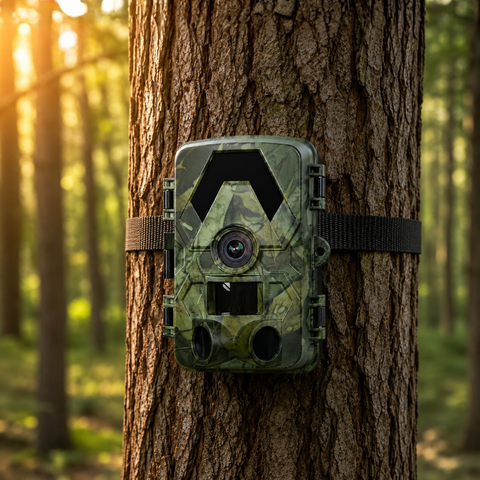

Good trail camera scouting in the weeks before the season is what separates guesswork from a real plan. Done right, it tells you which animals are using the ground, when they move, and where to sit on opening day.
Why pre-season trail camera scouting matters
A camera left running for a few weeks gathers more honest intel than any number of dawn walks. You learn movement patterns without disturbing the area, you confirm which individual animals are around, and you build a picture of timing that holds up when the season opens. The goal isn't a folder of nice photos. It's a small number of well-placed cameras feeding you decisions: where to set up, when to be there, and which spots aren't worth your time.
Where to place cameras
Coverage beats quantity. Spread a handful of cameras across the locations animals actually use rather than clustering them in one promising-looking patch. Placement is the single biggest factor in the quality of your intel, and it's worth getting right before you commit a camera to a tree. Our guide on where to place a trail camera goes deeper, but these are the spots that earn their keep during scouting season.
Trails and pinch points
Established trails are the obvious starting point, but the real value is in pinch points: a gap in a hedge, a saddle between two slopes, a gateway, or a crossing where terrain funnels animals into a narrow lane. One camera on a good pinch point can cover movement that would otherwise need three cameras to catch.
Water and food sources
Water draws traffic in dry spells, and food sources concentrate animals predictably. Field edges, feeders, mast-bearing trees and crop margins are all worth a camera. These are high-traffic spots, so expect to check them more often and burn through more storage.
Field edges and approaches
Cameras facing along a field edge, rather than straight out into open ground, catch animals as they enter and exit. This tells you the approach routes you'll want to intercept later, which is often more useful than knowing the field gets used at all.
Which camera goes where
Match the camera to how often you can realistically check the spot. For remote ground you'd rather not disturb, a cellular camera that sends images to your phone is the right tool. For closer spots you pass anyway, a camera with an on-board screen lets you review and reposition on the spot.
| Spot type | Recommended camera | Why |
|---|---|---|
| Remote, rarely visited | 4G Solar Trail Camera 4K | Dual-SIM 4G with auto network switch sends images to your phone; solar plus rechargeable battery keeps it running unattended; 0.3s trigger and no-glow IR to 25m |
| Spots you check on foot | 4G+ Trail Camera | Built-in 2.4 inch colour screen lets you review footage and adjust aim in the field; 4K, 36MP and no-glow IR to 20m |
Both run no-glow infrared, so animals never see a flash and your scouting stays low-impact. You can compare the full range in the trail cameras collection, and the best sellers are a good shortlist if you want the proven options.
Timing through the season
Start scouting earlier than feels necessary. Several weeks out, you're learning the lay of the land and which areas hold animals at all. As the season approaches, shift cameras toward the spots producing the most consistent activity and tighten your focus on movement times. Patterns change as feed and behaviour shift, so a camera that was quiet in early scouting may light up later, and vice versa. Keep moving cameras based on what they tell you rather than leaving them where you first hung them.
What intel to gather
Photos are only useful if you read them. Each time you pull images, log a few things rather than just admiring the haul:
- Movement times — note the timestamps and build a rough picture of when each spot is active. Repeated activity in the same window is your sit time.
- Individual animals — learn to recognise specific animals by markings, antler shape or size. Knowing it's the same animal returning is far more useful than a high photo count.
- Direction of travel — which way are they moving, and at what time? This tells you where to set up and from which side to approach.
- Wind and conditions — cross-reference active days against weather so you know what conditions get animals on their feet.
The pre-season trail camera scouting checklist
Pack this before you head out to hang and service cameras:
- Cameras, plus a couple of spares for spots you discover on the day
- Fresh batteries and a charged power bank for rechargeable units
- A solar panel for any remote camera you don't want to revisit for weeks
- Spare storage — a 128GB SD card per camera so high-traffic spots don't fill up before you return
- Straps, mounts and a few extra tree screws
- SIM cards activated and tested for your cellular cameras
- Phone with the camera app installed and logged in
- A small notebook or notes app for logging spots, times and individual animals
- Pruning shears to clear branches and grass from the camera's field of view
- Marking tape or pins to record exact camera locations
- Gloves and scent control to keep your intrusion minimal
How early should I start scouting before the season?
Several weeks out is sensible. Early scouting lets you find where animals are holding without pressure, then refine toward the most productive spots as the opener nears. Starting late leaves you reacting instead of planning.
How often should I check my trail cameras?
It depends on the spot. Remote ground is best left alone, which is why a cellular camera that sends images to your phone earns its place there. Spots you already pass can be checked more often, and a camera with a built-in screen lets you review on the spot without pulling the card.
Will checking cameras spook the animals?
It can, which is why low-impact scouting matters. No-glow infrared means no visible flash, cellular cameras cut the number of visits to remote spots, and basic scent control on the cameras you do check keeps your disturbance down.
How many cameras do I need to scout properly?
Enough to cover your key spot types — a pinch point, a water source, a food source and a field edge — rather than a fixed number. A few cameras spread across the right locations tell you more than a pile in one area.
Once your cameras are out and the intel is coming in, the next step is matching the right model to each spot for the long run. Our full guide on how to choose a 4G trail camera walks through the features that matter for everything from remote scouting to season-long monitoring.
